

Matthew Gilbert

Matthew Gilbert conjures a singular fictive universe across his tapestries, sewn paintings, and sculptural installations. At first encounter, their cartoon-inflected surfaces radiate a childlike, almost saccharine delight; yet with even a moment’s sustained attention, that innocence curdles, and the work begins to unfold according to a distinctly oneiric logic, where reverie shades into unease.
His practice summons the lush, overdetermined storytelling of a digital dreamscape, translated through the slow, devotional labor of textile craft. Vivid, almost hallucinatory color; the elastic syntax of cartoon worlds; and vertiginous, impossible architectures evoke early video game environments and the unruly margins of underground comics. Yet these phantasmagorias are insistently material: acrylic yarn and embroidery floss tether the imagery to the hand, the body, the intimate scale of touch. What first appears as a Disneyesque stage set—something out of Snow White, all bright surfaces and legible charm—gradually reveals itself to be closer to the psychic terrain of the fairy tale’s submerged violence, its latent Freudian charge.
Gilbert’s imagery reads like a sequence of unstable tableaux: a red airplane lodged mid-crash into a medieval tower as pink clouds churn overhead; a moonlit canyon that resolves into a film set for a narrative from which we are both invited and withheld. These scenes shimmer between registers—cinematic and camp, eerie and tender—never settling, always on the verge of transformation.
Threaded throughout is a queer and Jewish sensibility, not declared identity but a felt persona: a poetics of anxious displacement, of watchfulness, of worlds constructed slightly askew from consensus reality. The theatricality of his staging, the charged artificiality of his palette, and the lush tactility of his surfaces all revel in artifice even as they insist, disarmingly, on sincerity. These are not ironic constructions but offerings—intimate, sometimes disquietingly so. At moments, the personal becomes literal: “Body fibres,” as they appear in checklists, incorporate the lint gathered from a partner’s navel, rendered with a forensic tenderness that collapses the distance between the abject and the devotional.
In the most recent works, that sensibility is distilled into something starker and more haunted. Rendered in white thread on black denim, these interiors—vaulted, ecclesiastical, or domestic—are emptied of narrative action and instead hold the charge of what has already transpired. A bed remains indented, a chair lies overturned, a door stands closed; the space itself seems to remember. The linear precision of the stitching reads almost as drawing, yet the material softness absorbs and mutes, as if the image were being recalled rather than seen. Here, Gilbert’s oneiric logic gives way to a quieter register: not the fever dream, but the afterimage—the moment upon waking when the dream’s emotional residue lingers, vivid and inexplicable.
Though he resists repetition at the level of form, Gilbert’s sensibility remains unmistakable: sweet and feral, sensual and bruised, his works linger as invitations into a world where delight and dread are held in exquisite, uneasy suspension.
Artist Website
Artist CV

Flat Parts on Their Buzzcuts, 2024. Acrylic Yarn. 64 x 40 in.
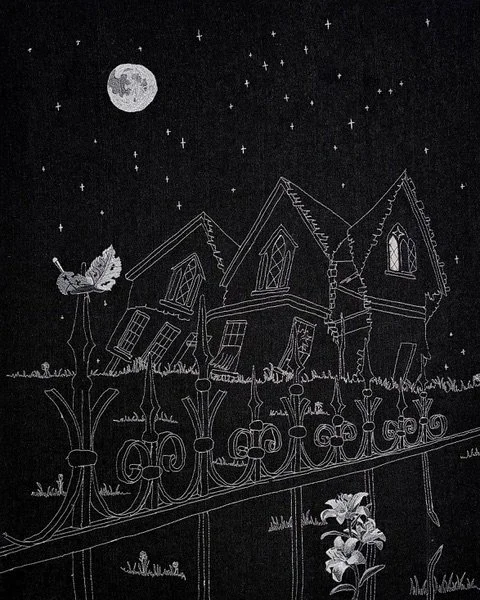
Scared of the Rain by God, 2026. Polyester thread, denim, wool, lint. 35 x 28 in.
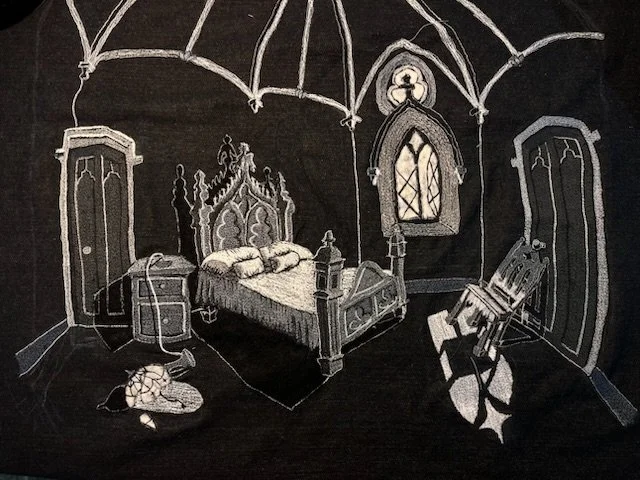
The Ache of the Wind on the Window, 2025. Polyester thread, black denim, wool, lint. 18 x 28 in.
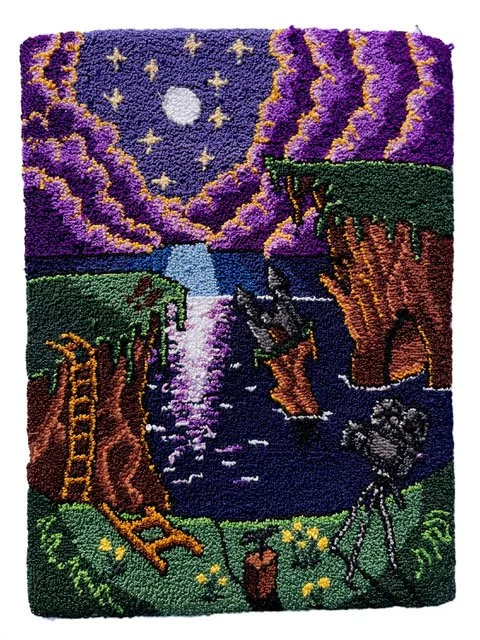
A Witness Watching, 2025. Embroidery Floss, Body Fibers. 13.5 x 10 in.